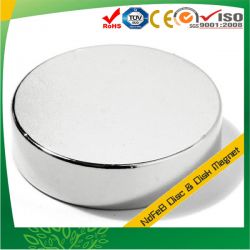
Original Manufacturer:HangSeng Magnetech / HSMAG / HS Magnetics
Solution:Customized you required material, grade, size, coating, shape, grade, pull force and woking temperature
Origin:Ningbo, Zhejiang, China
Supply Ability:50000pcs/day
Certification:SGS,TUV,ISO9001,ROHS,TS16949
Applications:Motors,Couplings,Sensors,Holding systems,Loudspeakers,microphones and much more.
Detailed Product Description:
Magnetisation Grade: N40 Material: Neodymium-Iron-Boron (NdFeB) Magnet ID: ND-12030-N40 Plating / Coating: Nickel (Ni-Cu-Ni) / Double Ni / Zinc (Zn) / Epoxy (Black/Gray) Shape: Disc, Disk, Cylinder, Round Disc Magnet Size: Disc Total Diameter (D): 120 mm Disc Total Height (H): 30 mm Tolerance: ±0.05 mm Magnetisation Direction: Axial / Radial Residual Magnetic Flux Density (Br): 1250-1280 mT (12.5-12.8 kGs) Energy Density (BH)max: 302-326 KJ/m³ (38-41 MGOe) Coercivity Force (Hcb): ≥ 907 kA/m ( ≥ 11.4 kOe) Intrinsic Coercivity Force (Hcj): ≥ 955 kA/m ( ≥ 12 kOe) Maximum Operation Temperature: 80 °C Delivery Time: 14-35 days PERMANENT MAGNETS A permanent magnet is made from a material that is magnetised and creates its own persistent magnetic field. An everyday example is a refrigerator magnet used to hold notes on a refrigerator door. Materials that can be magnetised, which are also the ones that are strongly attracted to a magnet, are called ferromagnetic (or ferrimagnetic). These include iron, nickel, cobalt, some alloys of rare earth metals, and some naturally occurring minerals such as lodestone. Although ferromagnetic (and ferrimagnetic) materials are the only ones attracted to a magnet strongly enough to be commonly considered magnetic, all other substances respond weakly to a magnetic field, by one of several other types of magnetism.