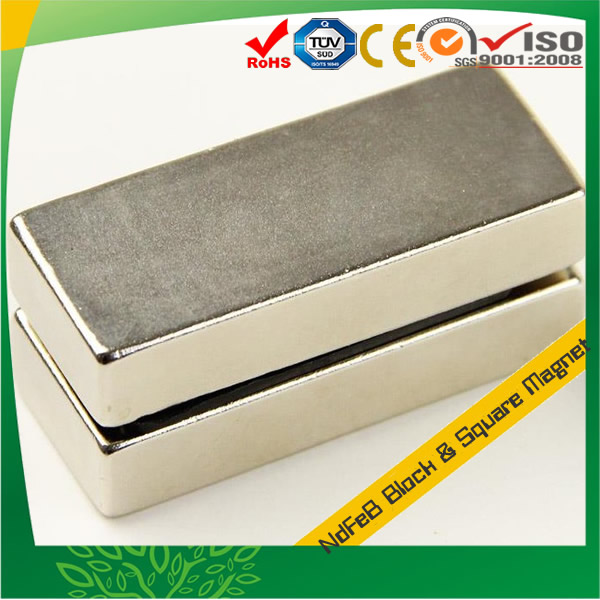
Magnetisation Grade: N38H
Material: Neodymium-Iron-Boron (NdFeB)
Magnet ID: NB-803010-N38H-Ni
Plating / Coating: Nickel (Ni-Cu-Ni) / Double Ni / Zinc (Zn) / Epoxy
Shape: Block, Rectangle, Square, Rectangular, Oblong, Diamond
Block Magnet Size:
Block Total Long (L): 80 mm
Block Total Height (H): 30 mm
Block Total Width (W): 10 mm
Tolerance: ±0.05 mm
Magnetisation Direction: Axial / Radial
Residual Magnetic Flux Density (Br): 1220-1250 mT (12.2-12.5 kGs)
Energy Density (BH)max: 287-310 KJ/m³ (36-39 MGOe)
Coercivity Force (Hcb): ≥ 899 kA/m ( ≥ 11.3 kOe)
Intrinsic Coercivity Force (Hcj): ≥ 1353 kA/m ( ≥ 17 kOe)
Maximum Operation Temperature: 120 °C
Delivery Time: 14-35 days
Neodymium (NdFeB) MAGNETS
Neodymium permanent magnets (Nd-Fe-B) are composed of neodymium, iron, boron and a few transition metals. These magnets are extremely strong for their small size, metallic in appearance and found in simple shapes such as rings, blocks and discs.
Attributes of Neodymium
Very high resistance to demagnetization
High energy for size
Good in ambient temperature
Moderately priced
Material is corrosive and should be coated for long term maximum energy output
Low working temperature for heat applications, but higher levels of heat resistance materials are being introduced periodically.
Applications of Neodymium
Magnetic separators, linear actuators, microphone assemblies, servo motors, DC motors (automotive starters), computer rigid disc drives, printers and speakers.
Tolerances
For as pressed material, tolerance on the thickness (direction of magnetization) is ± .005. Other dimensions are ± 2.5% or ± .010, whichever is greater. According to IMA standards, visual imperfections such as hairline cracks, porosity and minor chips are commonly found in sintered metallic magnets. A chipped edge is considered acceptable if no more than 10% of the surface is missing. Cracks are acceptable as long as they do not extend across more than 50% of pole surface.